
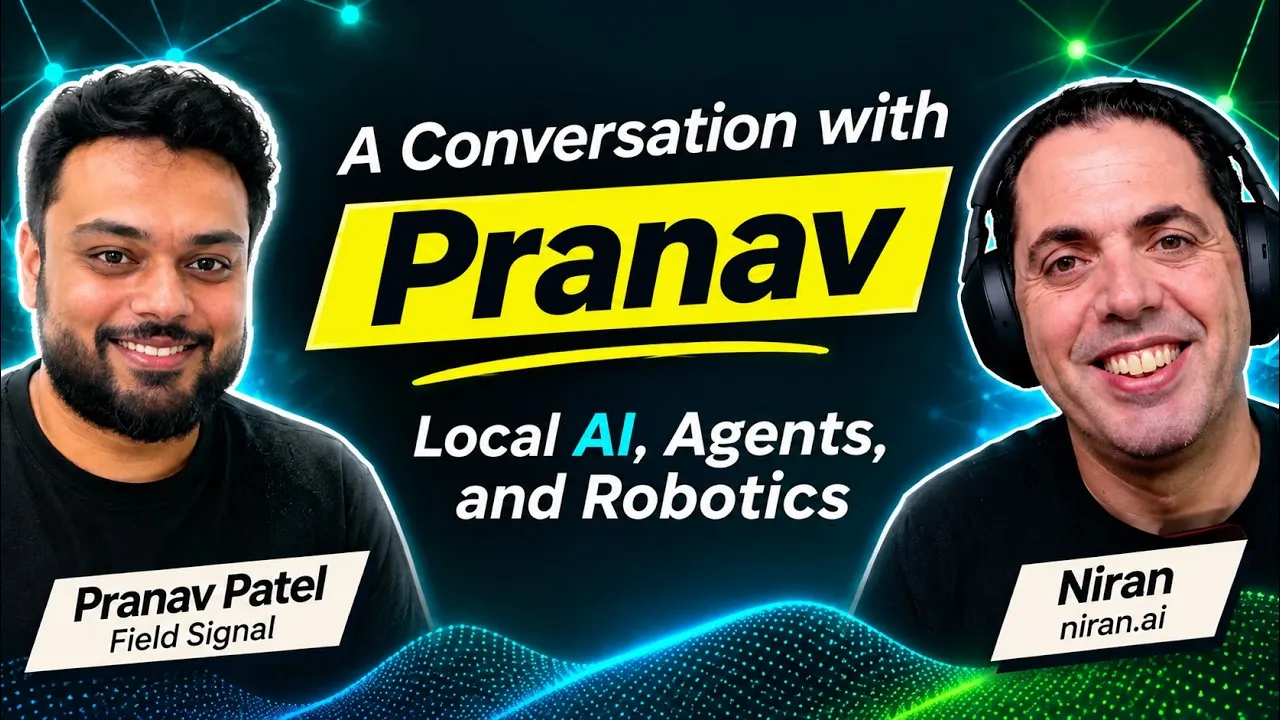
A Conversation with Pranav: Local AI, Agents, and Robotics
Comparing notes with Pranav Patel on local AI, DGX Spark, agents, and robotics, and probably the first of many conversations like this.
I sat down with Pranav Patel to compare notes on what we’ve been doing with AI in our home labs. We’ve both been spending quite a bit of time running models, building agents, and trying things just to see what happens, so I figured we should record one of these conversations.
This is probably the first of many talks with Pranav. I’m also thinking about doing more conversations like this with other people who are building and experimenting. No fixed schedule or grand plan yet. For now, it’s another way to share what we’re learning.
Local models, agents, and a robotic duck
We talk about running local AI on NVIDIA DGX Spark systems, including Pranav’s setup with two Sparks, and what we’re actually using these machines for.
That takes us into agents and some of the experiments we’ve been trying: an agent managing a fantasy football team, building a Pokémon-style website with a local model, and training a robotic duck using reinforcement learning. Some practical, some playful, but all useful ways to explore what these systems can do and where they struggle.
We also get into the questions that become harder once agents start doing real work. How much independence should we give them? How do we control their access and run them securely? And how do these experiments relate to enterprise AI?
Along the way, we discuss physical AI and robotics, and how much of the excitement around agents translates into something useful today. We’re sharing our own experiences, including the things that don’t quite work and the things we want to try next.
If you’ve been following my lab posts, this covers a lot of familiar ground, with another builder’s perspective added to the conversation.
Find Pranav’s work
You can explore Pranav’s projects at pranavpatel.tech and read his writing at Field Signal.
Watch the conversation above, or open it on YouTube.